Thank God They're on Our Side: The United States and Right-Wing Dictatorships, 1921-1965 by Schmitz David F
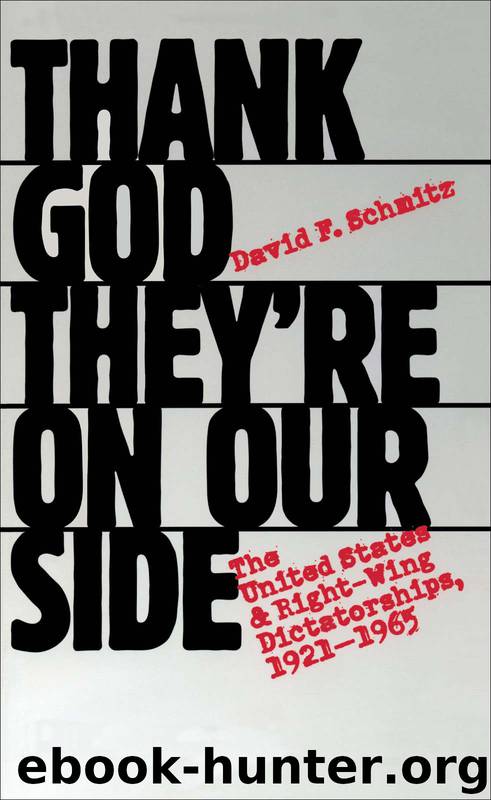
Author:Schmitz, David F. [Schmitz, David F.]
Language: eng
Format: epub
Publisher: University of North Carolina Press
Published: 1999-05-31T00:00:00+00:00
Reversing Guatemala’s 1944 Revolution
The Eisenhower administration’s successful overthrow of the Guatemalan government in 1954, along with the Bay of Pigs operation, is the most well known and studied example of CIA covert activity. It is unnecessary to recount here all of the planning and the operation itself.43 What is relevant to this discussion is how Guatemala represented to the administration the dangers of weak democratic states and why Eisenhower and his advisers believed that at certain times it was better to support a dictator than a freely elected government. As Thomas Mann later stated, the government in Guatemala demonstrated that the United States should not necessarily “support . . . all constitutional governments under all circumstances.”44
The overthrow of Ubico’s dictatorship in 1944 by the middle class and students ushered in the first truly democratic government in Guatemala’s history. In the presidential election held that year, Juan José Arévalo defeated General Federico Ponce. Arévalo initiated a series of reforms to institutionalize democratic structures and distribute power more broadly. In 1951, Jacobo Arbenz Guzman, the winner of the 1950 presidential election, took office and began to extend the reform movement begun under Arévalo to include social welfare programs and land reform. Arbenz believed that agrarian reform was essential if Guatemala were to progress economically and become a stable democratic society. Arbenz’s program called for the expropriation with compensation of all idle lands greater than 223 acres. Between 1952 and 1954 the government distributed over 1.5 million acres of land to one hundred thousand families. The United Fruit Company lost four hundred thousand acres, for which the government offered $1.2 million. The company rejected this settlement and demanded $75 an acre, for a total of $30 million. The ambitious attempt to create small landowners out of the mainly peasant population brought the Arbenz government into conflict with the United States and the United Fruit Company, the largest landowner in the nation.45
The Truman administration worried about the direction events were taking in Guatemala and the influence of communism in that nation but took no direct action against the government. From the outset, the Eisenhower administration demonstrated far greater concern about the events in Guatemala. Eisenhower saw Arbenz as a communist “dupe” who would soon lose control of his nation.46 In February 1953, Allen Dulles described the overall relations of the United States with Latin America as deteriorating and noted that his agency saw signs that the “Kremlin was exploiting this deterioration.” The United States “was confronting in Latin America a basically revolutionary movement not altogether unlike what existed in the Middle East.” The trends toward “economic nationalism, regionalism, neutralism, and increasing Communist influence . . . posed a direct danger to United States sources of supply for such strategic materials as copper, petroleum and tin.” The “most serious immediate situation was in Guatemala, where the development of pro-Communist influence was such as to mark an approaching crisis.”47
In March 1953, Eisenhower approved NSC 144/1 as the basis for policy toward Latin America. It called for
Download
This site does not store any files on its server. We only index and link to content provided by other sites. Please contact the content providers to delete copyright contents if any and email us, we'll remove relevant links or contents immediately.
| Anthropology | Archaeology |
| Philosophy | Politics & Government |
| Social Sciences | Sociology |
| Women's Studies |
The Secret History by Donna Tartt(19470)
The Social Justice Warrior Handbook by Lisa De Pasquale(12293)
Thirteen Reasons Why by Jay Asher(9120)
This Is How You Lose Her by Junot Diaz(7057)
Weapons of Math Destruction by Cathy O'Neil(6469)
Zero to One by Peter Thiel(5952)
Beartown by Fredrik Backman(5940)
The Myth of the Strong Leader by Archie Brown(5625)
The Fire Next Time by James Baldwin(5587)
How Democracies Die by Steven Levitsky & Daniel Ziblatt(5322)
Promise Me, Dad by Joe Biden(5229)
Stone's Rules by Roger Stone(5190)
A Higher Loyalty: Truth, Lies, and Leadership by James Comey(5089)
100 Deadly Skills by Clint Emerson(5023)
Rise and Kill First by Ronen Bergman(4891)
Secrecy World by Jake Bernstein(4886)
The David Icke Guide to the Global Conspiracy (and how to end it) by David Icke(4851)
The Doomsday Machine by Daniel Ellsberg(4623)
The Farm by Tom Rob Smith(4611)
